Wednesday, April 24, 2019

Step Up Your eLearning Game - Go for Hyper-Stories - Tip #209


Can you think of the most recent viral video or story you have seen and shared? What about it caught your attention? Let me guess. It probably made you laugh out loud, or tugged at your heartstrings, or got you so mad, or afraid even. But it surely moved your emotions enough to share it or extend the discussion among your friends. A study by Jan L. Plass et. al., among many others, have reported the significant influence of emotions on human cognitive processes, particularly learning, memory, and problem solving.

However, modern learners are impatient. According to an infographic from Bersin by Deloitte, online trainers now only have 5 to 10 seconds to grab the learners attention before clicking away. Thus, there is a constant need for learning strategies and approaches that facilitate instant learning. One effective method that we, as trainers, L&D designers, facilitators, SMEs can master is the art of using hyper-stories in our learning designs.

Hyper-Stories

Hyper-stories are the shortest and most emotional aspects of the story. By using hyper-stories, we are providing learners with content that is engaging, thought-provoking and purposeful.

4 Elements of an Effective Hyper-Story

Immediate meaning and context

According to Donald Hull’s definition of contextual learning, learning occurs only when learners connect information to their own frame of reference. The hyper-story is about making sure that the short video or idea brings out an experience from the learners. When they are able to understand the content based from their own interpretation, it is only then that lessons are relevant and useful to them.

Heighten involvement

A good hyper-story amplifies learner engagement. It ignites emotions and elicits learner response and reflection on the lesson you are trying to impart. A good tip when using a hyper-story, is to give the learners a good amount of time for reflection. Try the 10-90 rule (10% video or lesson, 90% reflection). Let it sink in. Allow them to internalize their own experiences in relation to the lesson ideas associated with it.

Faster application

Effective hyper-stories allow the learners to quickly connect the lesson to its application in real-life. When we design lessons for training, facilitate seminars or do workshops, always have a desired learning goal in mind - to build content that assists learners in their need for instant answers and solutions.

Instant recall

Hyper-stories in lessons help the learners be instantly reminded of their past experiences related to it. This accelerates the learning process. We all have a plethora of experiences and knowledge. Hyper-stories aid in tapping into this vast resource and reinforce what the learners already know.

Conclusion

The use of hyper-stories in lessons is an ingenious way to promote instant learning and to capture the emotions and attention of the modern learners. The connection between emotions and learning is undeniable. Learners learn faster by drawing from past experiences and reflection. Reflection deepens their own learning.

References

Tuesday, April 16, 2019

STOP, THINK, FOCUS: 4 Ways to Design Time-Saving Lessons - Tip #208


Who hasn’t been stuck in debilitating traffic or spent hours waiting in line? Have you ever taken a very long training course and wished you were someplace else? So much precious time wasted when you could’ve spent it doing other important activities. Everybody hates wasting time, especially the modern learners!


It was a couple of years ago when I was in Santa Monica when I learned of the BIRD scooters. I was so curious about how it worked and why it was such a hit. Well, for starters, it looked cool, fun, and convenient. One fascinating discovery though, was that you could also earn. You just went and picked up any BIRD scooter, recharged it, put it back from where you got it then you got paid through its app. Easy!

This illustration relates back to our training and learning industry. The challenge in creating courses sometimes is, we have a ton of ideas, data and content. We tend to include everything that we think is important. This results in a stretched out, bloated course. In the many years that I’ve worked with instructional designers, the “all content is important” mindset remains prevalent. How do we stop wasting our learner’s time and focus instead on what truly matters to them?

The Abstraction Process

The main concept of the abstraction process is prioritizing the essentials. From a large group of information or observation, try reducing it by finding some level of commonalities or patterns and then come up with a synthesis. We have a lot of these so-called mega time wasters in our training programs. In designing content, we need to make it simple, short, fast and immediately useful at work. We should focus on our learner’s needs and  information that can be helpful to doing their jobs faster and easier. How can you apply the abstraction process to remove time wasters in your training programs?


4 Ways to Design Time-Saving Lessons

1. Instant Needs

The most common challenges to training needs analysis are it’s too costly, takes months to finish, little opportunity to do, and it’s used sparingly, not all the time. It has all the potential to be a mega time waster. But what if we can do the abstraction process and simplify training needs analysis?  We get to have all the important answers we need and save a lot of time not just for the learners but the trainers as well.

Instant Needs Dynamic Assessment

Unlike training needs analysis, Instant Needs Dynamic Assessment has the following attributes:
  1. It is asked regularly or as often as needed.
  2. Only simple key questions are asked.
  3. It prioritizes the needs.
  4. It instantly provides suggestions and answers.


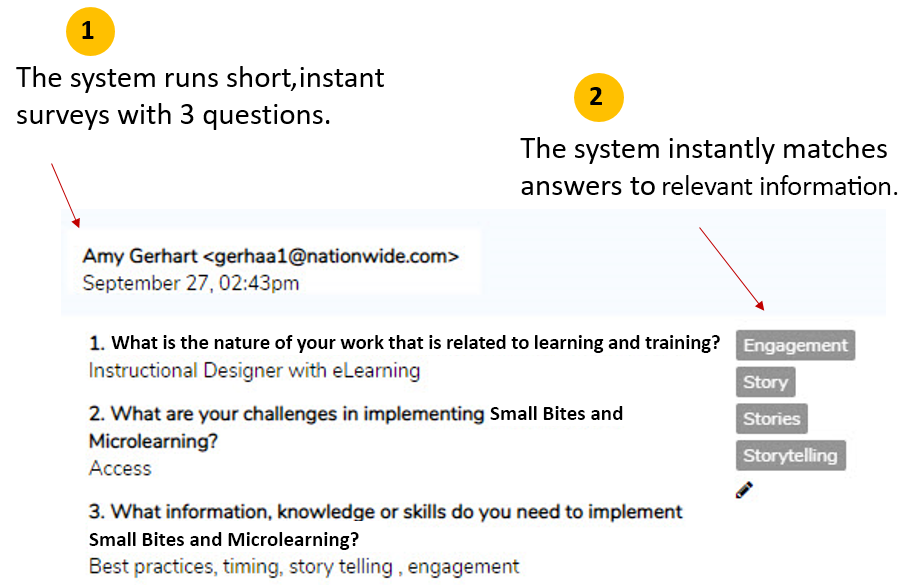
Click here for an enlarged view.

In the above examples, you are able to do the survey more regularly or as often as needed, by limiting the questions to three items. Whenever people answer the survey, the system provides a matching and relevant information. This way, learning is faster, more focused on their needs, personalized. In cases where there are no matching answers in the system, it will prioritize the answers according to levels of importance. This is how you determine which topics are helpful to them. Through their feedback you can refine your courses according to knowledge pertinent to the learners. Finally, the system will make suggestions and comments based on all the answers given. Imagine the amount of time saved by pinpointing the fundamentals. You are able to collapse a huge and problematic training needs analysis into something that is small, dynamic, and immediately useful to your learners.

2. Instant Answers

Why do we make learners go through an entire 3-hour course that can actually be done in 30 minutes? It doesn’t make any sense. We must do away with the “production” mindset and focus on the realities of the workers and learners - their need for easy, fast and useful solutions to actual work issues. Most of the time, simple and direct answers are all they need.

See the illustrations below.

How Do We Keep Hot Items On The Shelves? starts with a one-pager that is focused on 3 simple and very practical questions. If learners want to drill down and learn more, there is a Reference section that leads them to a more detailed lesson page.

Preview the example.
From this lesson page, they can again have access to more in-depth information to learn more. It could be a video, checklist, tip or a guide in the form of inventory reports or management systems. See example reference below.

Reporting Tool for Inventory Management Software - BarCloud
Click here for an enlarged view.

Notice how the lessons are layered and instant answers are drilled down. By designing your lessons this way, you are able to meet your learners’ needs for quick, easy to apply, and useful solutions and answers. Think of how much learners will appreciate that their time was not wasted on a long, boring course.

3. Instant Lessons

Which do you think is more likely to elicit a response from the learners: a long itemized list of do’s and don’ts of kitchen practices or a short lesson like the example below? Instant lessons work because learners can relate to the content very quickly. Cut to the chase. Use very relatable stories that not only allow learners to connect with and reflect on but would also suit your learning objectives. This way, they learn faster, no time wasted.

Preview an example below.

Kitchen Safety Practices
4. Instant Expertise

According to Harold Jarche, “Training as a knowledge delivery is dead.” With today’s ever-evolving work situations, training, in ways that we’ve done so in the past, won’t be as effective in dealing with the learners’ needs for instant solutions and faster decision-making. Today’s learners don’t just rely solely on SMEs anymore. Most of the time they find answers themselves or collaborate with peers simply because it saves a lot of time.
Click here for an enlarged view.

Conclusion

In today’s fast-paced world we live in, everybody has become used to what is fast, cost-saving, convenient, dynamic and can be used immediately. This also applies to the training industry. We have to do away with long, boring, costly, irrelevant courses that frustrates and wastes learner’s time. Try to rethink your learning strategies and be creative. Think out of the box. Wipe out unnecessary processes and aim for the shortest possible solutions. Abstraction process is one way. What other ways can you think of?  Share your thoughts with me.
Related Tips